Chronograph Watches Explained: Subdials, Pushers and Tachymeters
Learn what a chronograph measures, how its pushers and subdials work and what to verify before buying one.
A chronograph is a watch with an independent elapsed-time counter. One pusher normally starts and stops timing; another resets it. Subdial jobs and operating sequences differ by calibre, so identify the exact movement before using it.
Chronographs are popular because they add useful timing and visual depth, but a busy dial can be misunderstood. The central seconds hand may belong to the stopwatch while a small subdial shows normal running seconds.
Chronograph does not mean chronometer
A chronograph measures a time interval independently of the ordinary time display. A chronometer is a precision designation tied to testing or certification. A watch can be one, both or neither.
Mechanical, quartz and solar-powered chronographs exist. The complication describes the timing function, not the source of energy inside the watch.
Start, stop and reset in the correct order
The common two-pusher layout places start/stop near two o’clock and reset near four o’clock. Stop the chronograph before resetting unless the manual explicitly describes a flyback system. Forcing a pusher or using the wrong sequence can damage some movements.
Do not operate pushers underwater unless the manufacturer explicitly permits it for that model. Water resistance, crown position and pusher construction all matter.
- Start the timer with the designated pusher.
- Stop it before reading the elapsed time.
- Reset only according to the calibre instructions.
Subdial layouts are not universal
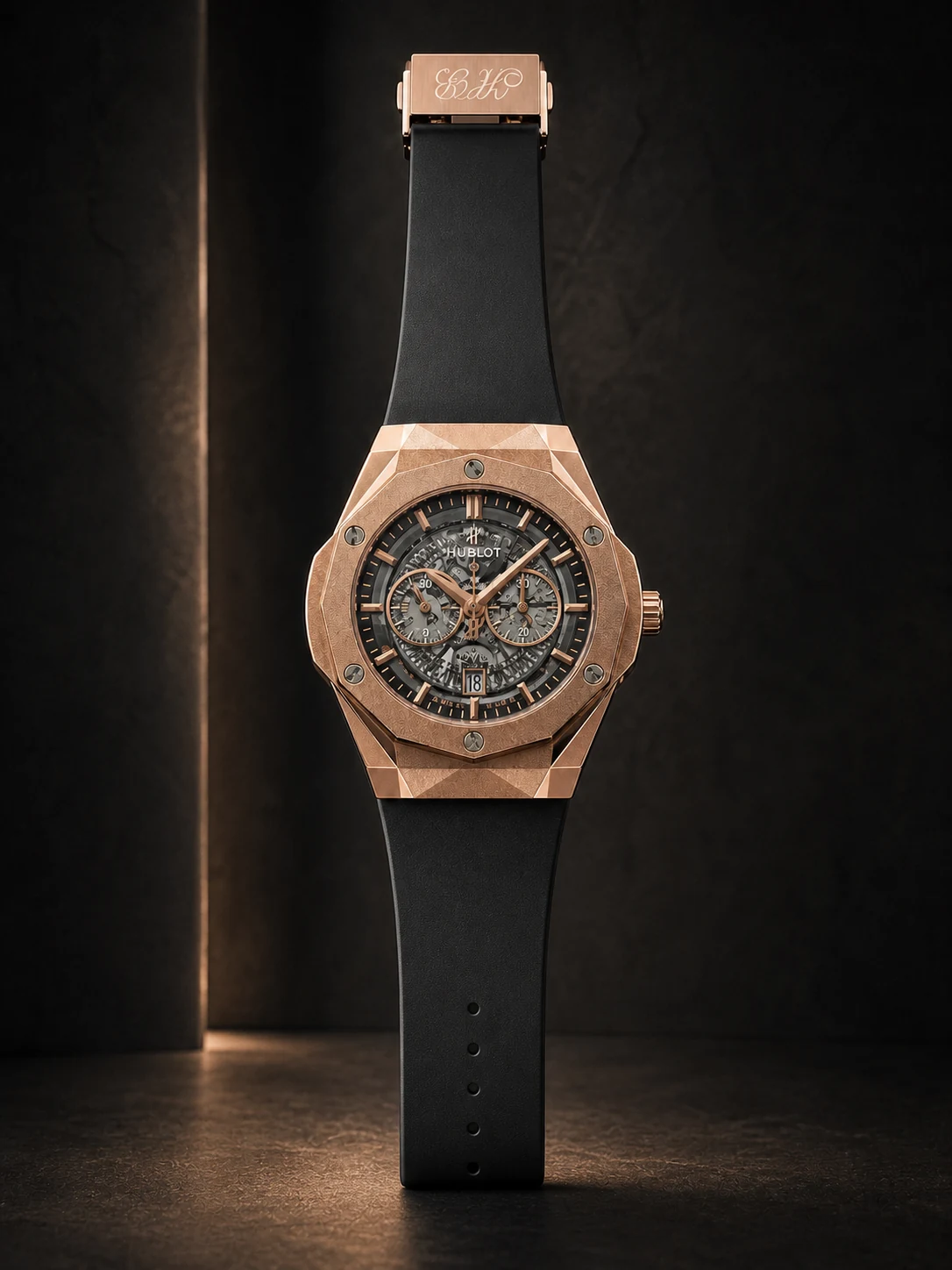
A three-register dial might show running seconds, elapsed minutes and elapsed hours. Another can replace elapsed hours with a 24-hour indicator or use the central hand differently. Marketing photos alone do not tell you the function of every register.
| Display | Possible job | How to verify |
|---|---|---|
| Central seconds hand | Elapsed chronograph seconds | Check whether it moves only after start |
| Small seconds subdial | Normal running seconds | Match its position to the manual |
| Minute or hour register | Accumulated elapsed time | Confirm its maximum timing capacity |
What a tachymeter actually calculates
A tachymeter converts elapsed time over a known unit distance into an average rate per hour. Start at the beginning of one kilometre, stop at the end and read the number indicated by the chronograph seconds hand. The same scale can measure units per hour when one unit takes less than a minute.
It does not measure distance on its own and it is not a speed sensor. Its result depends on a known distance and a steady interpretation of the scale.
Choose legibility before decoration
Check the calibre, timing capacity, subdial labels, date position, pusher feel, case thickness and water-use instructions. Reset hands should align precisely with zero; if they do not, follow the quartz correction procedure or have a mechanical watch inspected.
Time a short event, stop it, read every counter and reset it. If you cannot interpret the result comfortably, a simpler dial may serve you better.
Turn the guide into a shortlist
Use Watcher’s live filters, then verify the exact product code and specifications.
How this guide was prepared
The Watcher Editorial Desk separates general guidance from model-specific claims, uses current manufacturer or industry sources, and avoids inventing prices or specifications that can change. Always verify the exact product reference and manual before purchase or water exposure.
- Seiko — Automatic chronograph instructions — Official calibre instructions and tachymeter guidance for a mechanical chronograph.
- Citizen — Water resistance — Manufacturer guidance on ratings, appropriate use, crowns, gaskets and maintenance.
- Seiko — Accuracy of mechanical watches — Manufacturer guidance on daily rate, winding state, temperature, position, shock, magnetism and servicing.
Common questions
Can I leave a chronograph running?
Some can run continuously, but it may use more stored energy and add wear. Follow the movement instructions.
Why does the large seconds hand not move?
It may be the chronograph seconds hand; normal seconds may appear on a subdial.
Is every three-subdial watch a chronograph?
No. Subdials can show calendar, 24-hour or other information, so verify the stated functions.